The most underrated consequence of LLMs? They’ve ignited genuine debate about the nature of intelligence. We should be doing everything in our god-given capacity to encourage this open intellectual sparring.
I’ll share a current example, then explain why the people and platforms who create space for these debates and diversity of opinion are such an insanely valuable resource to the world.
Why defining intelligence is so hard
'What is intelligence?' - there are endless axes of debate.

Embodiment vs. abstraction, evolutionary vs. computational, even consciousness vs. cognition? I'm sure I've misrepresented the scope. I don't even know whether a post-LLM 'taxonomy of intelligence' exists or whether it should exist. Category labels like "functionalist" or "computationalist" are helpful for organising perspectives; they shouldn't be treated as rigid boxes that capture the full complexity of someone's thinking.
Something I find to be true 100% of the time: the more I dig into experts' views on a topic, the more nuance I uncover and the more uncertainty I discover. This nuance and uncertainty is extremely difficult to express in a single tweet, which is unfortunately the depth to which most of us consume most ideas and information. Many giga-brained individuals have dedicated their lives to making sense of 'the nature of intelligence' from all different angles and diverse backgrounds, and are now engaging in real-time open debate. Whether we embrace or suppress diverse opinions will fundamentally shape the future of humanity.
One especially interesting axis of debate with big implications is:
-
Intelligence is the ability to model, predict, and influence, vs.
-
Intelligence is doing more with less
I'll unpack these two competing(ish) views by Blaise Agüera y Arcas and David C. Krakauer.
Agüera: intelligence is the ability to model, predict, and influence
Blaise Agüera y Arcas is Vice-President & Fellow at Google and serves as CTO of Technology & Society. He founded Google’s Paradigms of Intelligence (Pi) team, which does foundational research on neural computing, evolution, artificial life, and what intelligence might be at its roots. Before Google he worked in software engineering, augmented-reality, mapping and computer vision. He views intelligence and life itself through a unified lens of computation, evolution, and prediction.
"The radical yet obvious alternative is to accept that large models can be intelligent, and to consider the implications. Is the emergence of intelligence merely a side effect of 'solving' prediction, or are prediction and intelligence actually equivalent? This book posits the latter."
What Is Intelligence? Lessons from AI About Evolution, Computing, and Minds (MIT Press, 2025)
Here is Blaise on the MLST podcast:
Brad’s post about the Blaise Agüera y Arcas conversation
Krakauer: intelligence is doing more with less
David C. Krakauer is President and William H. Miller Professor of Complex Systems at the Santa Fe Institute, a leading research centre for complex adaptive systems. His work treats intelligence (and life more broadly) as “problem-solving matter”: how biological, social, or cultural systems process information, adapt, and evolve. Melanie Mitchell joins him in arguing the other side of the ML intelligence coin.
"There is little reason to expect LLMs to be intelligent since all we have been training through endless benchmark targeting is hugely overparameterized capability. A gifted mathematician is clearly not just a vast assemblage of diverse calculators; they are much closer to an analogy-making system, typically in possession of rather poor calculators. A mathematician is described as intelligent because they can do 'more with less.'"
"Large Language Models and Emergence: A Complex Systems Perspective"
Here is David on the MLST podcast:
Brad’s post about the David Krakauer conversation
We need tension, not consensus
I'm not saying that trying to determine the better argument isn't important, it's critically important. I'm saying that in the face of uncertainty (which is where we are now), what we need is a marketplace of competing ideas.
This kind of tension should be treated as a public good; its philosophical, economic, and political implications cut across everything.
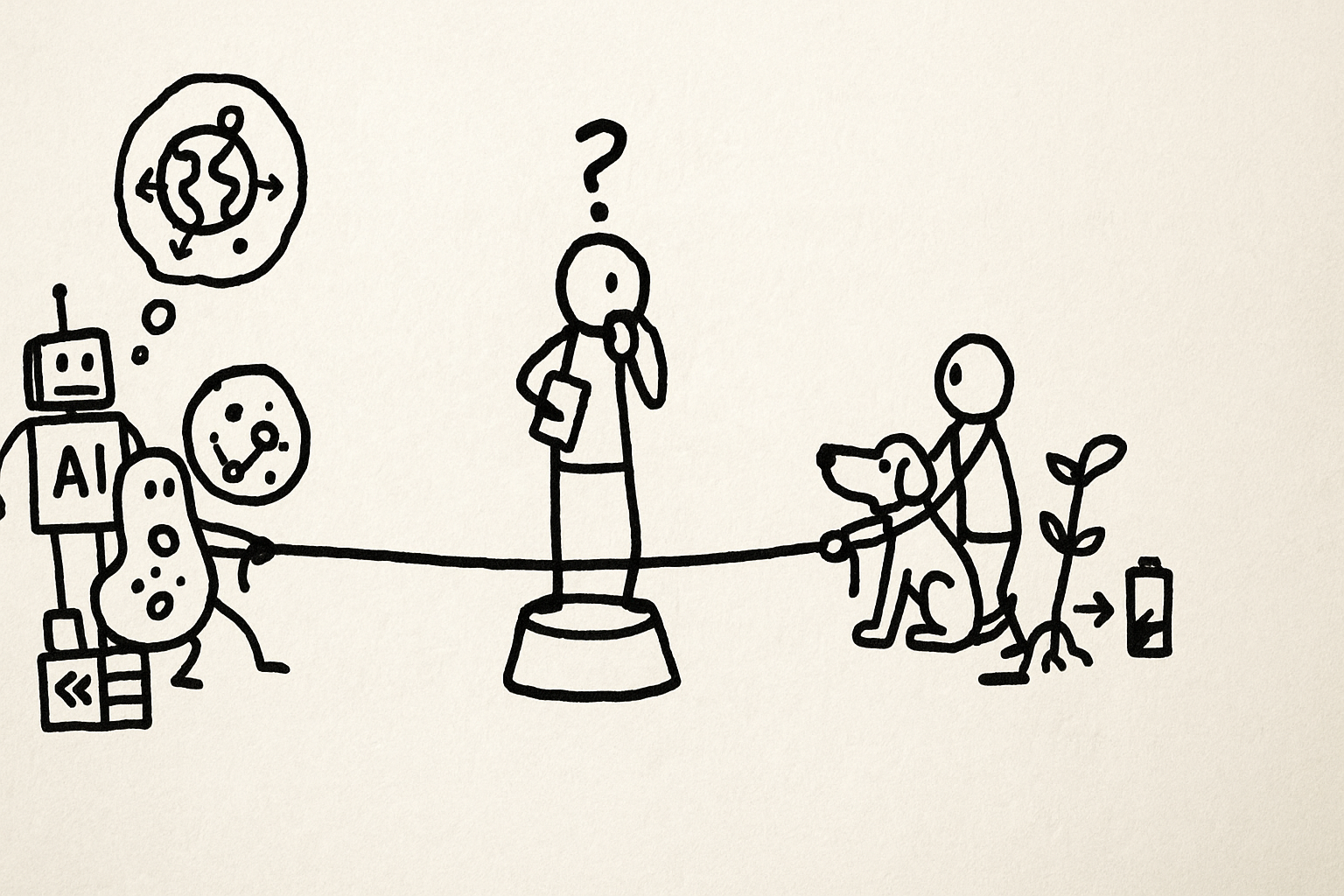
Agüera y Arcas's core argument is that life is computation, and effective prediction is intelligence, whether in bacteria, brains, or language models. If he's directionally right, LLMs aren't imitations; they're intelligent. The implications would be significant: we might be on a sharper trajectory toward AGI than many expect, and questions about moral consideration, labor protections, or even rights for AI systems become urgent. Our economic policies around automation would need complete rethinking.
Krakauer and Mitchell push the opposite way. Intelligence, for them, is fundamentally about compression and abstraction: doing "more with less". From this view, LLMs represent a kind of anti-intelligence. If they are right, then current AI systems are sophisticated but ultimately limited, meaning claims of AGI are premature, safety concerns might be overblown, and we're not nearly as close to transformative AI as some believe.
The interplay of these competing views will deepen our collective understanding and ultimately strengthen and/or refine the individual views. Having the other side of the debate gives us something concrete to grapple against. The more we dig into where these ideas truly converge and diverge, the more we learn about the nature of intelligence and the better prepared we'll be for what's coming.
Podcasting as an intellectual commons
The rise of podcasting as a medium for education and information could not have come at a better time.
I said this at the start of the essay:
Something I find to be true 100% of the time: the more I dig into an expert's views on any topic, the more I uncover nuance, and the more I discover genuine uncertainty.
There's something special about grappling with ideas in real time, guided by thoughtful questioning. It removes the technical shielding most experts place around their ideas in papers or books, forces externalisation, and allows ideas to be fully expressed with the required nuance.
But I want to highlight something else here.
You may have noticed that the same podcast and host presented both videos I shared above, featuring Agüera y Arcas and Krakauer. This might be subtle, but it shouldn't be understated. It's an art.

Machine Learning Street Talk channel
To extract real insights from thinkers at this caliber, a host must genuinely grapple with the ideas. This means challenging and intermingling them with their own beliefs. The guest must trust the host enough to share openly, and that trust only comes when the guest believes the host will truly listen, respond honestly, and genuinely consider what they're saying. This requires a level of open-mindedness and humility far beyond the norm. The host must be willing to set aside concern and ego, what the audience might think of them and their beliefs, and let the guest speak fully.
Very few people can do this well.
But for the ones who can, something magical happens: when a podcaster facilitates and engages with genuinely opposing viewpoints on the same platform, it opens the door for listeners (and guests) to have their own views challenged, refined and/or changed. That's exactly what we need if we're going to make progress on subjects as complex and gnarly as the nature of intelligence.
We, as an audience, should actively protect and encourage this diversity of thought and debate, while actively discouraging shallow keyboard-warrior-esque harassment in the YouTube and Twitter comments.
The alternative is a world where consensus views are aired, thinkers self-censor to avoid controversy, and everyone piles into their chosen echo chambers.
Needless to say, this is not where we want to end up.
A curated list of conversations covering 'the nature of intelligence'
For your viewing pleasure, I've curated some examples which span a diverse range of opinions on the nature of intelligence. These podcasts all have incredibly high production quality, do in-person conversations and cover 'the nature of intelligence'.
Machine Learning Street Talk (as above) Machine Learning Street Talk channel
- David C. Krakauer: David C. Krakauer on MLST
- Blaise Agüera y Arcas: Blaise Agüera y Arcas on MLST
- Francois Chollet: François Chollet on MLST
Lex Fridman Lex Fridman podcast channel
- Michael Levin: Michael Levin on Lex Fridman
- Demis Hassabis: Demis Hassabis on Lex Fridman
Dwarkesh Patel Dwarkesh Patel podcast channel
- Richard Sutton: Richard Sutton on Dwarkesh
- Andrej Karpathy: Andrej Karpathy on Dwarkesh
- Ilya Sutskever: Ilya Sutskever on Dwarkesh
Latent Space Podcast (more technical) Latent Space Podcast channel
- Noam Brown: Noam Brown on Latent Space
- Fei-Fei Li and Justin Johnson: Fei-Fei Li and Justin Johnson on Latent Space
References
- Blaise Agüera y Arcas on Machine Learning Street Talk.
- David Krakauer on Machine Learning Street Talk.
- Large Language Models and Emergence: A Complex Systems Perspective.
- Brad Morris: the Blaise Agüera y Arcas conversation.
- Brad Morris: the David Krakauer conversation.
- Blaise Agüera y Arcas: What Is Intelligence?. MIT Press.