‘Recursive self-improvement’ is at the core of much of the excitement (and concern) about AI progress. Better AI builds even better AI, progress accelerates, things get weird, fast.
In a recent conversation between Ryan Greenblatt and Dwarkesh Patel:
“Whether or not this turns out to be the case, I think is the most important question in the world right now.”
Ryan’s belief is that once AIs get about as good as the best human experts at AI research and development, they will kick off a feedback loop. And this loop could compress four or five years of normal AI progress into a single year.
For an idea carrying this much weight, there’s surprisingly little agreement about what it actually means or how likely it is to happen.
It’s clear that AI is already helping us build better AI. But that doesn’t automatically lead to the kind of self-sustaining intelligence explosion most people have in mind when it comes to RSI.
Even if Ryan is correct, and human researchers and expert human data are not the limiting factor, and rapidly increasing AI capabilities compress many years of progress, it does not mean we automatically have a feedback loop that will sustain itself.
Given the ungodly amounts of compute, data and human labour fuelling AI progress, and the fact that frontier labs share very little about how much AI is actually contributing to progress, it’s very difficult to separate progress driven by better AI from progress driven by pouring in more external resources.
But disentangling this is necessary.
If we stopped pouring in more compute, data and human labour, would better AI keep progress accelerating? Or would that acceleration fade?
In The Economics of Recursive Self-Improvement paper, the Elasticity Institute (in my opinion) has done some of the most useful and important work on RSI.
They offer a more helpful definition of RSI: “Self-Sustaining Acceleration”.
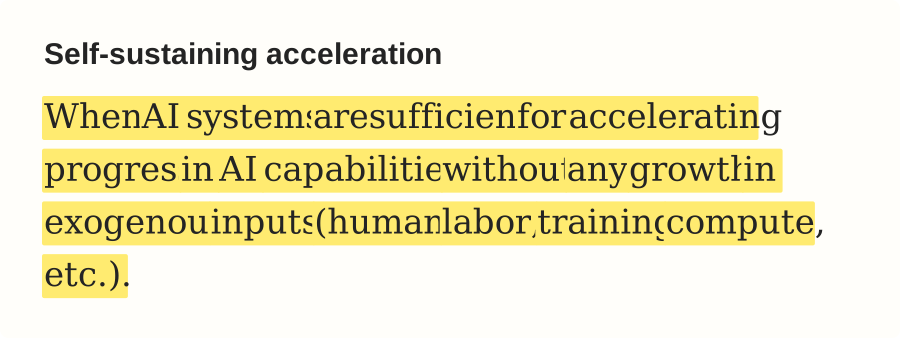
They then build a series of models to explore what would make this acceleration possible, what could hold it back, and whether the evidence suggests we’ve crossed that threshold.
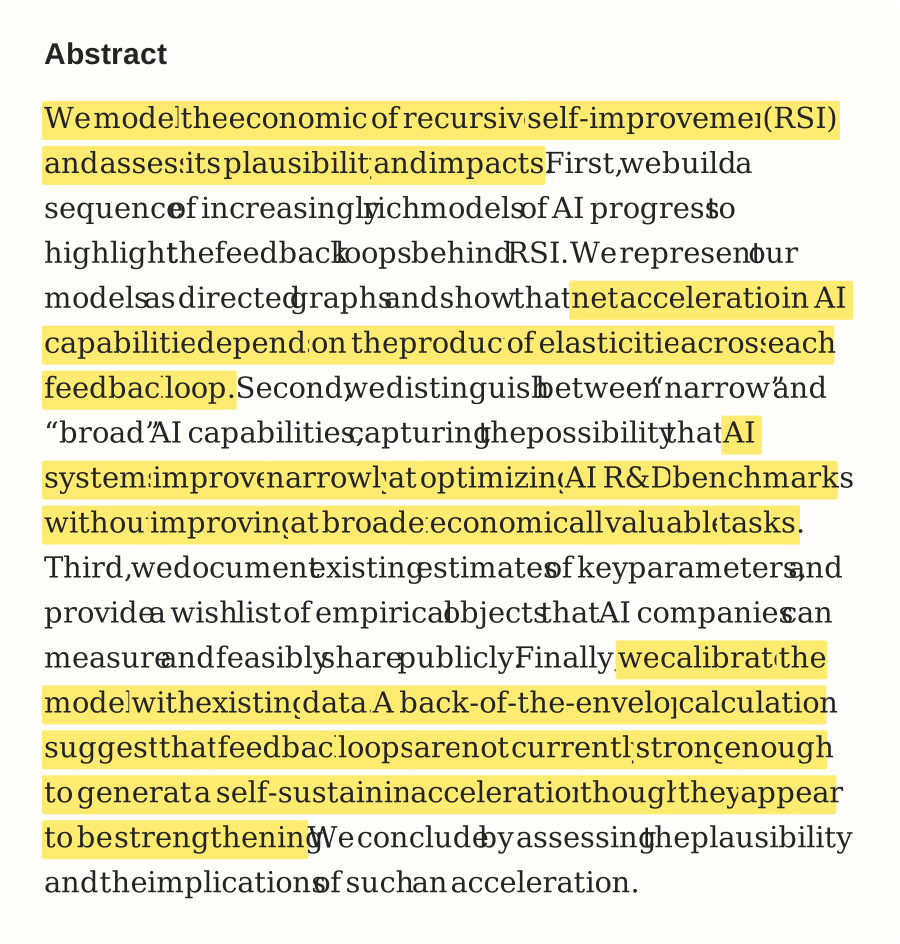
The main takeaways
-
AI doing AI research doesn’t automatically mean an intelligence explosion. Progress can still run into diminishing returns and limits on compute, data or human input.
-
Their rough estimates suggest we’re not yet at self-sustaining acceleration. Better AI isn’t yet improving research enough to keep progress accelerating without adding more resources.
-
That could change. AI’s contribution to research appears to be growing, but the numbers are highly uncertain.
-
AI could get much better at improving AI without getting equally better at everything else. Rapid progress in AI research wouldn’t necessarily mean equally rapid progress across the wider economy.
-
We need better data from labs. Especially on how much AI actually improves the entire research process, rather than individual tasks.
Self-sustaining acceleration
Recursive self-improvement is inconsistently defined. This is largely the result of overly broad or overly narrow interpretations of how it might play out.
The broad scenario is that AI helps us build better AI. Technology has always helped improve technology (wheels making carts to transport better materials, to make better wheels etc).
The narrow scenario is that AI takes over the entire process: choosing research goals, running experiments, implementing changes, and deploying better versions of itself.
Neither of these scenarios helps us measure whether progress will keep accelerating.
AI is already helping us build better AI, and while ‘full automation’ may one day come, it’s not a necessary prerequisite.
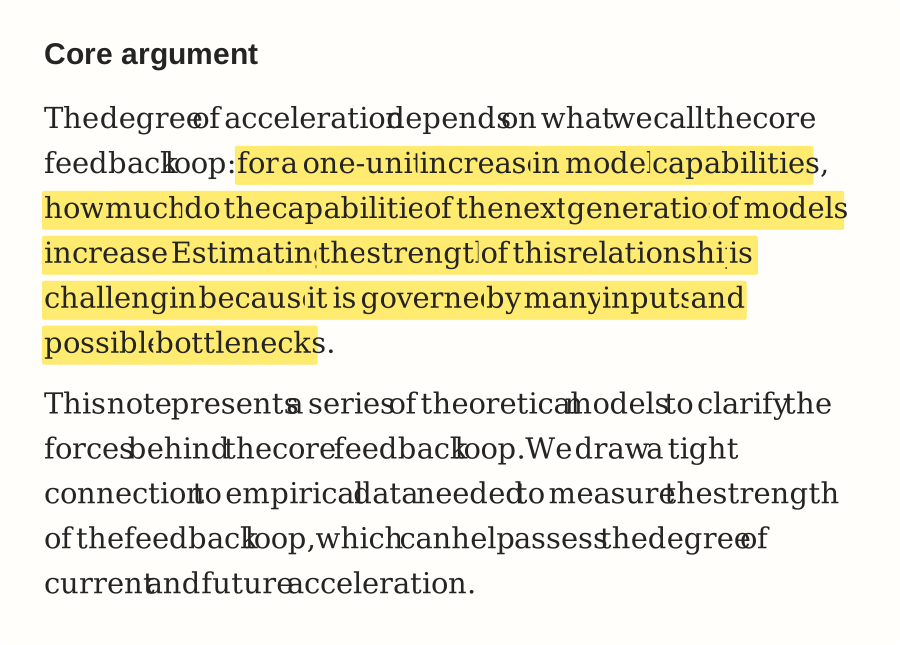
Measuring self-sustaining acceleration means measuring how much better AI contributes to building subsequent AIs. In simple terms: if you hold exogenous inputs fixed (human labour, compute, data), are AI’s own improvements enough to keep progress speeding up?
How do we model self-sustaining acceleration?
A helpful intuition pump here is pointing a microphone at a speaker.

The microphone picks up sound from the speaker. The system amplifies it and plays it back through the speaker, creating a feedback loop. Whether it grows into a screech or fades out depends on how much signal survives and is amplified on each trip around the loop. If each trip returns a weaker signal, the loop fades. If it returns a stronger one, it compounds.
Similarly, each round of model improvements helps researchers produce the next.
The question is whether that feedback is strong enough to keep progress accelerating from round to round, despite diminishing returns and without adding more people, compute or data.
If not, better AI still helps, but it won’t sustain acceleration on its own.
It’s worth pausing for a moment on this.
It sounds obvious, but it’s the part missing from most RSI discourse: we need to tease apart and measure how much ‘better AI’ contributes to building subsequent AIs. Without this, we really have no idea whether or not the loop compounds and becomes self-sustaining, or fades - bottlenecked by the other inputs.
Doing this is difficult because better AI isn’t the only thing driving progress. Labs are also adding more compute, data and human labour. And we don’t have visibility into how much of the overall improvement comes from better AI versus the other inputs.
The basic bottleneck model (measuring the inner loop)
There are many ways AI could speed up its own development (too many ways to unpack in a single paper). For example, AI could help build better chips, or generate wealth that would enhance and fund more efficient research and more compute.
For this reason, the paper focuses its attention on a basic bottlenecks model - allowing them to measure the core AI improves AI research loop, holding external inputs fixed.
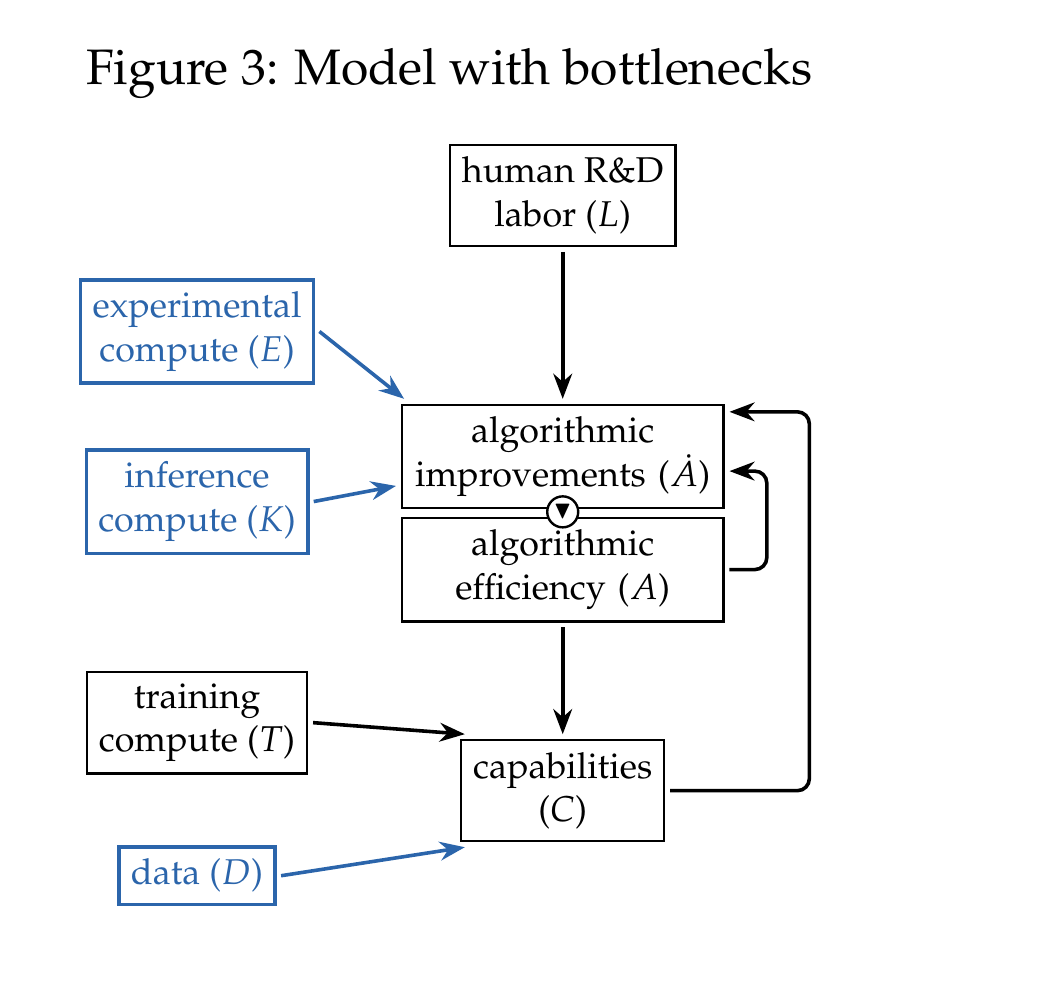
I’ve simplified the paper’s models and diagrams to make the core idea easier to follow.
This is the core loop we want to isolate and measure.
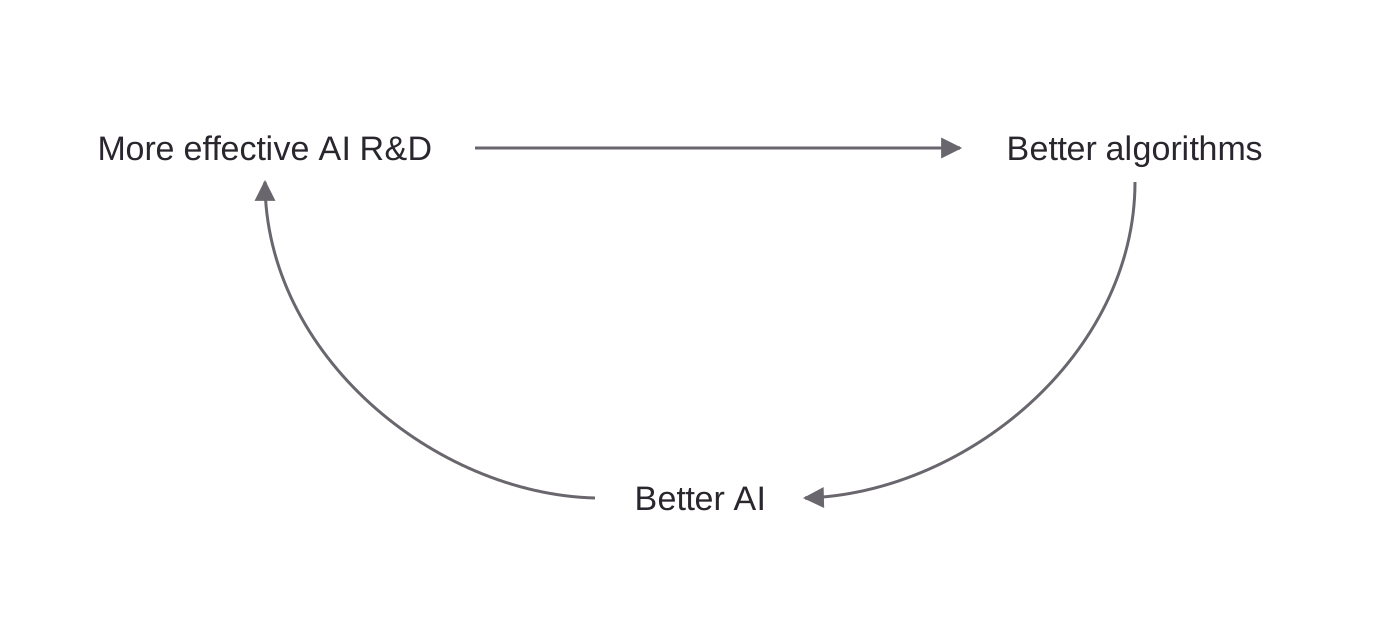
Research improves algorithms, better algorithms make better AI, and better AI helps with the next round of research. We want to know:
- How much algorithmic progress we get from a given amount of R&D
- How much those improvements make the next AI model better
- How much that better AI contributes back to the total R&D process
The paper uses elasticities - a standard economic tool used to explain how much one thing changes in response to another. Combining them shows whether the loop is strong enough to sustain acceleration.
As mentioned earlier, we don’t know (3) how much better AI contributes back to total R&D versus the other inputs. But we can estimate the other two links.
So the paper works backwards.
Given we know roughly (1) how much research improves algorithms, and (2) how much those improvements lead to better AI, we can use these to determine how strong better AI’s contribution would need to be to sustain acceleration with no increase in people, compute or data.
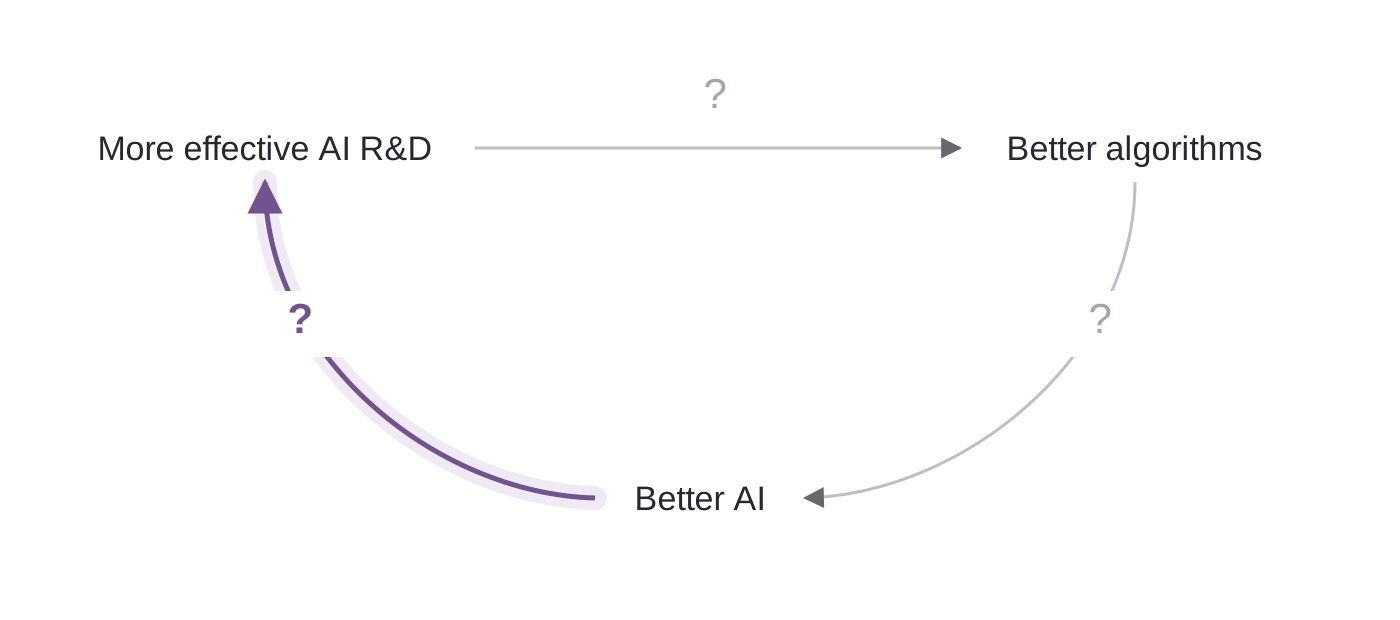
At the threshold: ? × ? × ? = 1
The paper uses existing research to estimate the first two links.
(1) How much does research improve algorithms?
For their rough calculation, the authors estimate that algorithmic efficiency and total research effort have both grown about threefold annually. Comparing these growth rates gives a return-to-research estimate of roughly one.
The paper’s rough calculation (pp. 28–29).
(2) How much do better algorithms improve AI?
To understand how better algorithms contribute to better AI, we need a consistent way to compare model capabilities. This is difficult given how quickly models are being released and how quickly benchmarks saturate.
Epoch’s Capabilities Index (ECI) combines results from different benchmarks into a common scale, allowing us to compare models over time.
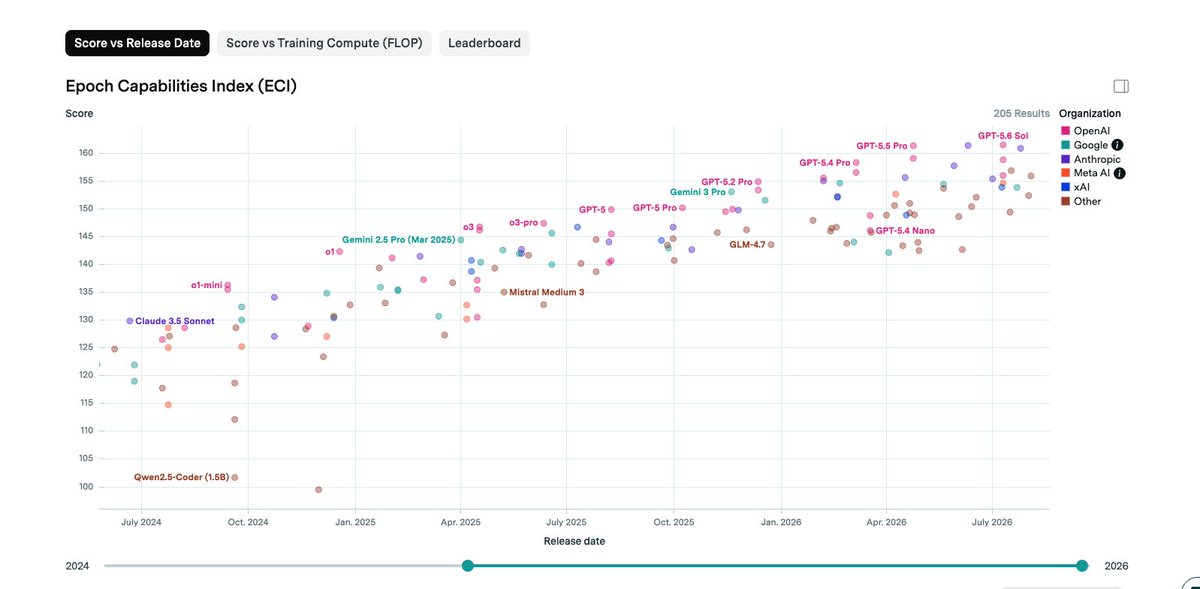
The paper assumes that improving algorithmic efficiency has the same effect as increasing training compute by the same proportion - both let a model do more with available resources.
Under that assumption, they estimate that a 1% improvement in algorithmic efficiency adds roughly 0.065 ECI points. See the 6.5 in the equation.
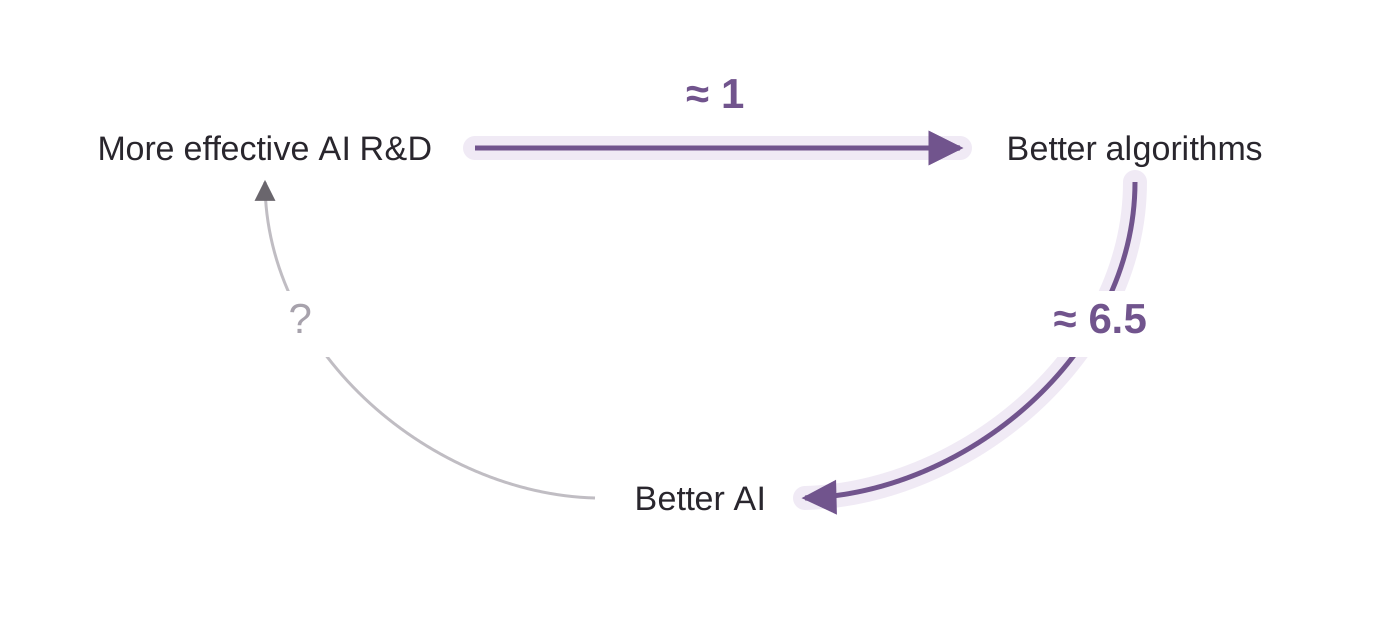
At the threshold: 1 × 6.5 × ? ≈ 1
Explained another way:
For a lab to produce a model one ECI point better than the last, it would need roughly 15% greater algorithmic efficiency, which requires roughly 15% more effective research. So with the same people, compute and data, the lab’s research would need to become roughly 15% more effective simply by using the better model.
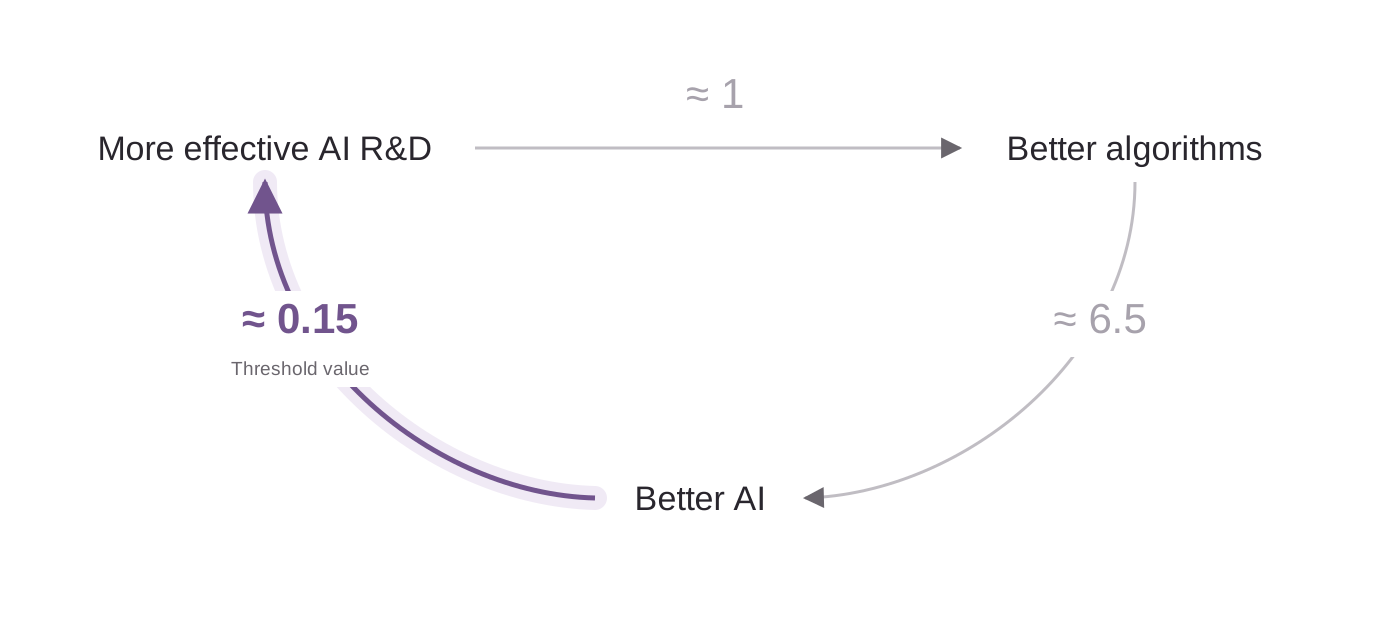
At the threshold: 1 × 6.5 × 0.15 ≈ 1
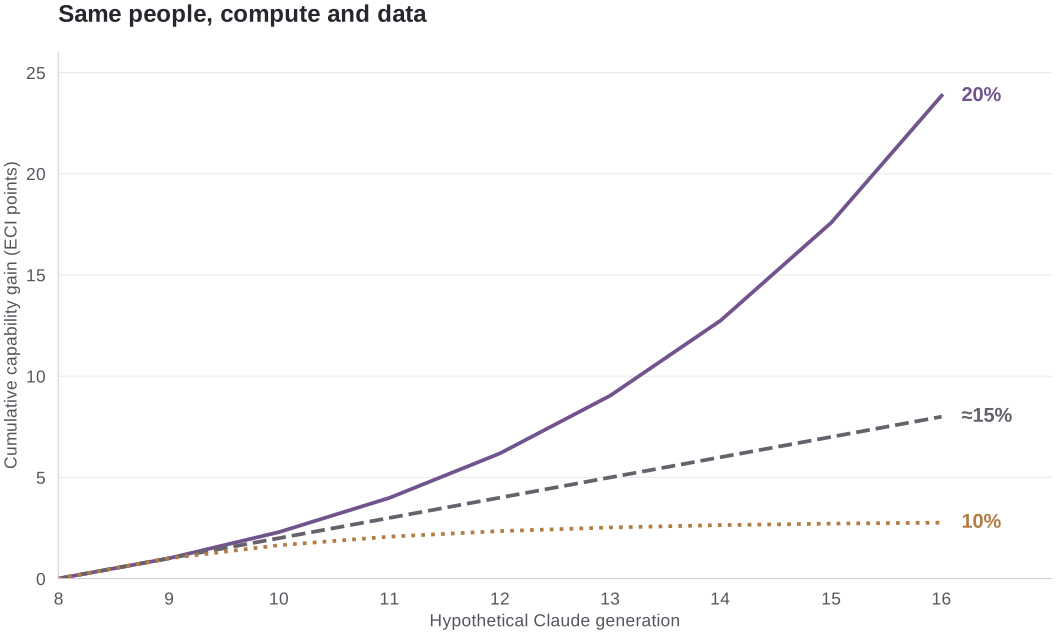
Imagine a hypothetical scenario where future models—Claude 8, Claude 9, Claude 10, and so on—were released. Each model helps researchers build the next, with no increase in people, compute or data.
The chart compares three possibilities: each extra ECI point makes the overall research process 10%, roughly 15%, or 20% more productive. At 10%, each new model improves by less than the one before. At roughly 15%, each improves by about the same amount. At 20%, each improves by more than the one before.
How close are we to self-sustaining acceleration?
If the model requires roughly 15% more research productivity per ECI point for self-sustaining acceleration, where are we now?
The reality is - we don’t know.
Without better data and reporting from the labs, we can only guess.
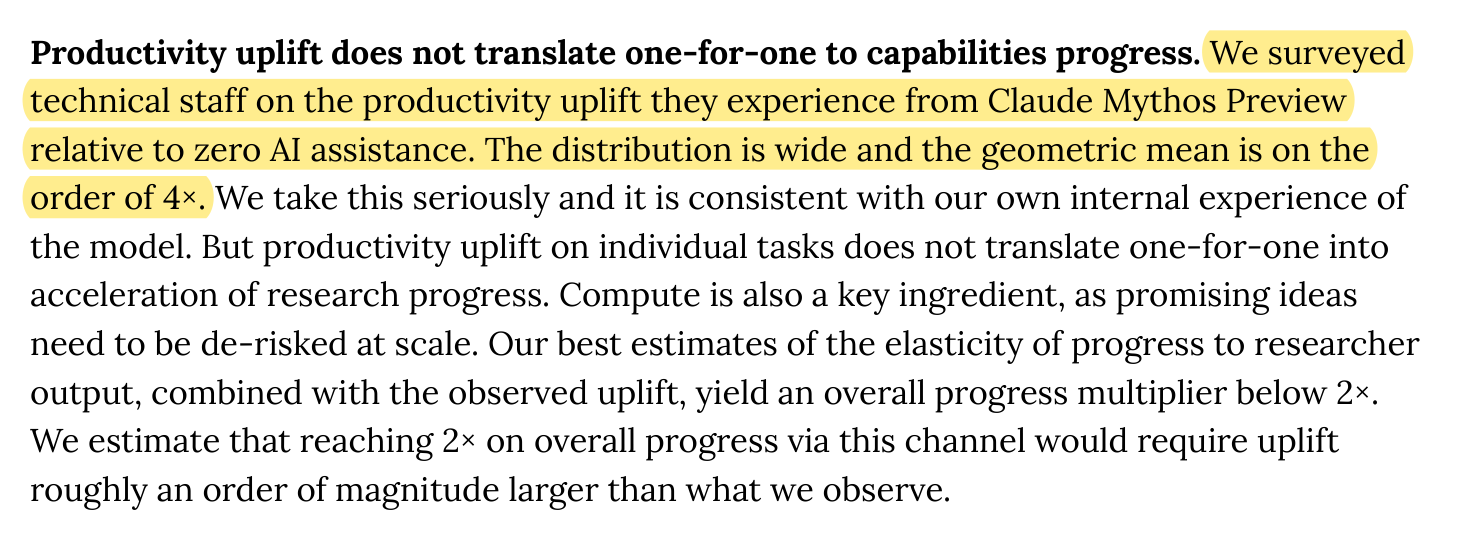
The paper uses a self-reported Anthropic engineer productivity survey to make a rough estimate of how much productivity increased as Claude improved.
Around Sonnet 3.7’s release, there was little clear evidence that AI coding tools improved productivity.
In the April 2026 Mythos Preview system card, technical staff reported being roughly four times as productive with the model as without AI assistance. (Anthropic’s report)
They take that fourfold productivity gain and spread it across the 16 ECI points between Sonnet 3.7 and Opus 4.8. That works out to roughly 9% more productivity per ECI point, below the paper’s 15% threshold.
This is a rough comparison across the period, rather than a direct test of those two models against each other. The paper combines the Opus 4.8–Sonnet 3.7 capability gap with the separate Mythos survey.
Obviously, these numbers are highly uncertain. It’s a very rough comparison, and individual engineer productivity is not the same as total end-to-end AI R&D productivity.
The conclusion
The models and estimates put current progress below the self-sustaining acceleration threshold.
But the authors are very clear that the numbers are uncertain and that the feedback loops might be getting stronger.
The case for takeoff: AI is already helping labs write code, run experiments and improve models. If each generation becomes more useful at this work, it could help produce the next generation faster - strengthening the feedback loop.
The case against: Faster coding and experiments may not solve the harder research problems. Easy improvements could run out, while progress still depends on scarce compute, data and human judgment. Funding, infrastructure and political constraints could also slow things down.
For something with such high stakes, recursive self-improvement remains surprisingly poorly understood. We still lack agreement on what it means and reliable measurements to help gauge whether it’s happening.
Ideally, we’d have more visibility into how R&D spending is divided across people and compute, and how much real research progress AI is producing.
The paper explicitly asks for this data.
References
-
Dwarkesh Patel: Ryan Greenblatt: What happens once AI can automate AI research? Dwarkesh Podcast, 11 August 2026. Primary source for Ryan’s forecasts, the debate over expert data, AI R&D automation, diminishing returns, and the quotations used in the essay.
-
Tom Cunningham, Lukas Althoff, Basil Halperin, Brian Jabarian, Andrew Koh, Arjun Ramani, Phil Trammell, Parker Whitfill, and Cheryl Wu: The Economics of Recursive Self-Improvement. Elasticity Institute, 13 July 2026. Primary source for the definition of self-sustaining acceleration, the bottlenecks model, the elasticity framework, the 15% threshold, the rough 9% estimate, and the requested data disclosures.
-
Parker Whitfill and Tom Cunningham: The Economics of Recursive Self-Improvement. METR, 22 July 2026. Accessible summary of the paper’s motivation, definition problem, bottlenecks, calibration, uncertainty, and data requests.
-
I. J. Good: Speculations Concerning the First Ultraintelligent Machine. Advances in Computers, vol. 6, 1965, pp. 31–88. Original source for the “ultraintelligent machine” and “intelligence explosion” argument.
-
Anson Ho, Tamay Besiroglu, Ege Erdil, David Owen, Robi Rahman, Zifan Carl Guo, David Atkinson, Neil Thompson, and Jaime Sevilla: Algorithmic Progress in Language Models. NeurIPS, 2024. Source for the historical estimate that language-model algorithmic efficiency improved by roughly 3× annually, while also finding that compute and data scaling explained most measured progress.
-
Anson Ho, Jean-Stanislas Denain, David Atanasov, Samuel Albanie, and Rohin Shah: A Rosetta Stone for AI Benchmarks. Epoch AI, 2 December 2025. Technical foundation for the Epoch Capabilities Index and long-run comparisons between models and benchmarks.
-
Epoch AI: Epoch Capabilities Index Documentation. Methodological documentation for ECI, the composite capability measure used in the Elasticity Institute paper.
-
Epoch AI: Trends in Artificial Intelligence. Updated 5 February 2026. Current trend data covering model capabilities, training compute, compute stock, hardware performance, and algorithmic efficiency.
-
Marina Favaro and Jack Clark: When AI Builds Itself. Anthropic Institute, 2026. Primary source for Anthropic’s internal evidence, including the employee survey reporting roughly 4× self-assessed output with Claude Mythos Preview. Anthropic explicitly cautions that the true uplift was probably lower.
-
Joel Becker: Measuring the Self-Reported Impact of Early-2026 AI on Technical Worker Productivity. METR, 11 May 2026. Useful context for my skepticism about the 4× figure: 349 technical workers reported a median 1.4–2× increase in work value, while METR found reasons to suspect that larger self-reported estimates are overstated.
People and organizations on X
-
Dwarkesh Patel: @dwarkesh_sp
-
Ryan Greenblatt: @RyanGreenblatt
-
Epoch AI: @EpochAIResearch
-
Elasticity Institute: @ElasticityInst
Paper authors on X
-
Tom Cunningham: @testingham
-
Lukas Althoff: @AlthoffLukas
-
Basil Halperin: @BasilHalperin
-
Brian Jabarian: @brian_jabarian
-
Andrew Koh: @andrewjkoh
-
Arjun Ramani: @arjun_ramani3
-
Phil Trammell: @pawtrammell
-
Parker Whitfill: @whitfill_parker
-
Cheryl Wu: @cherylwoooo